Resistance Band Exercises for Kids' Posture
- Juliana Lucky

- May 15
- 7 min read
Resistance bands are one of the most underused tools in children's posture correction. They are inexpensive, lightweight, and come in different resistance levels that make them perfect for growing bodies. In my practice, I have seen children who resisted floor exercises become genuinely excited about resistance band exercises kids posture work because the bands feel more like toys than training equipment.
The stretchy pull of a band gives children immediate sensory feedback. They can feel the resistance, they can see the band stretch, and that visual and physical cue helps them understand which muscles are working. For kids with rounded shoulders, a weak upper back, or general slouching, resistance bands target exactly the muscle groups that matter most. Here are six band exercises I use with my own daughters (ages 5 and 9) and recommend to parents in my programs.
Why Resistance Bands Work for Kids' Posture
Good posture depends on a balance of strength between the muscles on the front and back of the body. In most children with poor posture, the muscles across the chest and the front of the shoulders are tight, while the muscles of the upper back, rear shoulders, and deep core are weak. This imbalance pulls the shoulders forward and lets the spine round.
Resistance bands address this imbalance directly. Pulling a band apart or pulling it toward the body strengthens the upper back muscles (the rhomboids, middle trapezius, and rear deltoids) that hold the shoulder blades in place. A review published in the British Journal of Sports Medicine found that resistance training in youth improves muscular strength, motor skill performance, and body composition when done with proper guidance. Bands are an ideal entry point because the resistance is progressive and the risk of injury is very low.
Compared to body-weight exercises, bands also allow children to isolate specific muscles more easily. A child who cannot feel their upper back working during a floor exercise will immediately feel it during a band pull-apart. That muscle awareness (what specialists call proprioception) is the foundation of lasting resistance band posture kids improvements. Once children can feel the right muscles firing, they start using those muscles throughout the day without thinking about it.
Choosing the Right Resistance Band for Your Child
Bands come in different resistance levels, usually color-coded. For children, start with the lightest resistance available. Most brands use yellow or light pink for their easiest band. The American Academy of Pediatrics supports resistance training for children when exercises use light loads, proper form, and adult supervision.
Here is a simple guide by age:
Ages 4 to 6: Extra-light resistance (thin tube or flat band). Focus on playful movements and short sets of 5 to 8 repetitions.
Ages 7 to 9: Light resistance. Sets of 8 to 10 repetitions. Children can begin holding positions for 3 to 5 seconds at the end range.
Ages 10 to 12: Light to medium resistance. Sets of 10 to 12 repetitions. Form should be the focus before moving up in resistance.
Flat therapy bands (the kind you buy by the yard or in rolls) tend to work better for kids than tube bands with handles. They are easier to grip, gentler on small hands, and can be tied into loops for certain exercises. A single flat band about 5 feet long can handle every exercise in this article.
6 Resistance Band Exercises for Kids' Posture
These exercises target the muscles responsible for upright posture: the upper back, rear shoulders, core, and scapular stabilizers. Do them barefoot on a flat surface. Each exercise takes less than a minute.
1. Band Pull-Apart
Stand with arms straight out in front at shoulder height, holding the band with both hands about shoulder width apart. Pull the band apart by squeezing the shoulder blades together until the band touches the chest. Slowly return to the starting position. This is the single most effective band exercises children posture correction move because it directly strengthens the muscles that pull the shoulders back. Do 8 to 10 repetitions, pausing for 2 seconds at the end of each pull.
2. Overhead Band Stretch
Hold the band overhead with both hands wider than shoulder width. Keep arms straight and gently pull the band apart while reaching upward. Hold for 5 seconds, then relax. This exercise opens the chest, lengthens the side body, and activates the muscles along the spine that keep the torso upright. It also counteracts the forward-leaning position that children adopt during screen time. Do 6 to 8 repetitions.

3. Seated Row
Sit on the floor with legs straight out in front. Loop the band around the feet and hold one end in each hand. Sit up tall and pull the band toward the belly button, squeezing the shoulder blades together at the end. Slowly release. This exercise strengthens the entire upper back chain and teaches children what an upright seated posture feels like. It pairs well with the posture exercises for kids I recommend for desk posture habits. Do 8 to 10 repetitions.
4. Monster Walk
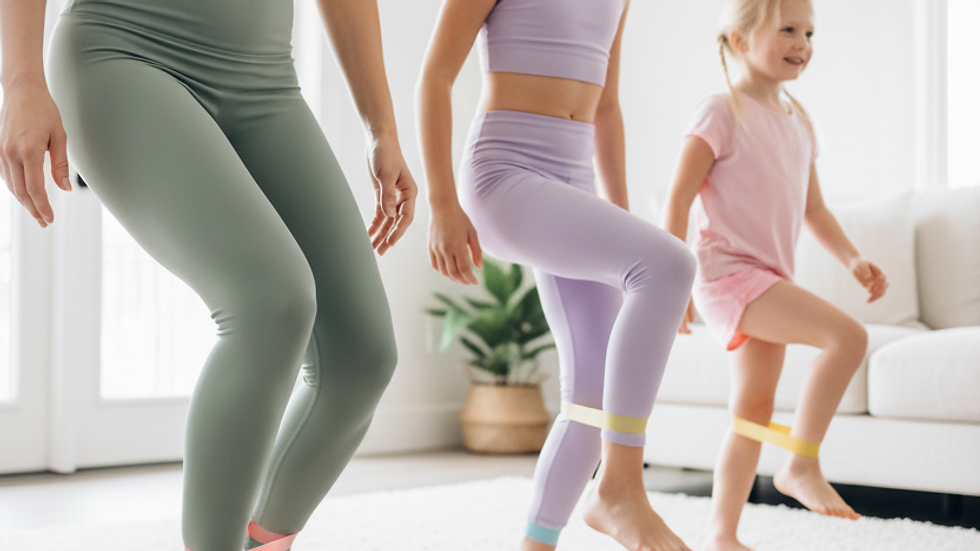
Tie the band in a loop around both ankles. Stand with feet hip-width apart, knees slightly bent, and hands on hips. Take 10 small steps to the right, then 10 to the left. The band forces the hip stabilizers (the gluteus medius) to work with every step. Strong hip muscles support pelvic alignment, which is the base of good spinal posture. Kids love this one because it looks and feels like a monster stomping. Do 2 to 3 sets in each direction.
5. Wings of the Airplane (with Band)
This is a band-assisted version of the Wings of the Airplane exercise from my Posture and Feet course. Stand on the middle of the band with both feet. Hold the ends at hip level, palms facing backward. Raise both arms out to the sides (like airplane wings) until they reach shoulder height, keeping the arms straight. Lower slowly. The band adds resistance to the movement, making the rear deltoids and upper back work harder than in the bodyweight version. Do 8 to 10 repetitions.
6. Core Press-Out
Stand with the band wrapped behind the back and held in both hands at chest level. Press both hands straight out in front of the body against the band's resistance. Hold for 3 seconds with arms fully extended, then bring hands back to the chest. This anti-extension exercise trains the deep core muscles that stabilize the spine. It teaches children to brace the midsection while moving the arms, which is a skill they use every time they sit, stand, or carry a backpack. Do 8 to 10 repetitions.
A Simple Weekly Band Routine for Better Posture
Consistency matters more than volume. Here is the weekly schedule I use with my own kids:
3 days per week (for example, Monday, Wednesday, Friday)
Pick 3 exercises per session from the list above (rotate which 3 you choose)
1 to 2 sets of each exercise
Total time: 8 to 12 minutes per session
According to KidsHealth, children can safely do resistance training 2 to 3 days per week with at least a day of rest between sessions. Keep the mood playful. Let children pick which exercises they want to do. If they lose interest in one move, swap it for another. The goal is building a habit they will stick with, not perfecting every repetition.
My 9-year-old prefers the band pull-apart and the Wings of the Airplane because she can feel her back muscles working. My 5-year-old gravitates toward the monster walk because it makes her giggle. Both approaches are valid. The muscles get trained either way. If your child is also working on exercises to correct slouching, adding band work 2 to 3 times per week accelerates the results because bands provide a level of resistance that bodyweight alone cannot match for the upper back.
You May Also Like
Test Your Knowledge: Resistance Bands and Kids' Posture
See how much you picked up from this post. Check your answers below each question.
1. Why are resistance bands effective for correcting kids' posture?
a) They stretch tight muscles only
b) They strengthen the upper back muscles that hold the shoulder blades in place and provide sensory feedback
c) They replace all other exercises
d) They only work for adults
Answer: b) They strengthen the upper back muscles that hold the shoulder blades in place and provide sensory feedback. The visual and physical cue of the stretching band helps children understand which muscles are working.
2. What resistance level should a 5-year-old start with?
a) Medium resistance
b) Heavy resistance
c) Extra-light resistance with short sets of 5 to 8 repetitions
d) No resistance band at all until age 10
Answer: c) Extra-light resistance with short sets of 5 to 8 repetitions. Young children should use the lightest band available and focus on playful movements with proper form.
3. Which exercise is the most effective single move for pulling shoulders back?
a) Monster Walk
b) Core Press-Out
c) Band Pull-Apart
d) Overhead Band Stretch
Answer: c) Band Pull-Apart. It directly strengthens the rhomboids and middle trapezius, which are the muscles responsible for retracting the shoulder blades.
4. How does the Monster Walk help posture?
a) It stretches the hamstrings
b) It strengthens the hip stabilizers that support pelvic alignment
c) It only works the ankles
d) It improves arm strength
Answer: b) It strengthens the hip stabilizers that support pelvic alignment. Strong gluteus medius muscles keep the pelvis level, which is the base for good spinal posture.
5. How often should kids do resistance band exercises for posture?
a) Every day for 30 minutes
b) 2 to 3 days per week, 8 to 12 minutes per session
c) Once a month
d) Only when they have pain
Answer: b) 2 to 3 days per week, 8 to 12 minutes per session. Consistency at a moderate frequency builds strength effectively while allowing adequate recovery between sessions.
A Full Program Built Around These Exercises
Resistance band exercises are one piece of a larger posture correction approach. My Posture and Feet course gives families a structured, video-guided program that combines strengthening, stretching, and alignment exercises designed for children of all ages.
A few minutes of targeted work each day adds up to visible changes in how your child stands and moves.




Comments