May 5, 2026
Upper Back Exercises for Kids with Poor Posture
Upper back exercises for kids with poor posture, explained by a child posture specialist. Six moves that strengthen the muscles between the shoulder blades and help kids sit taller.
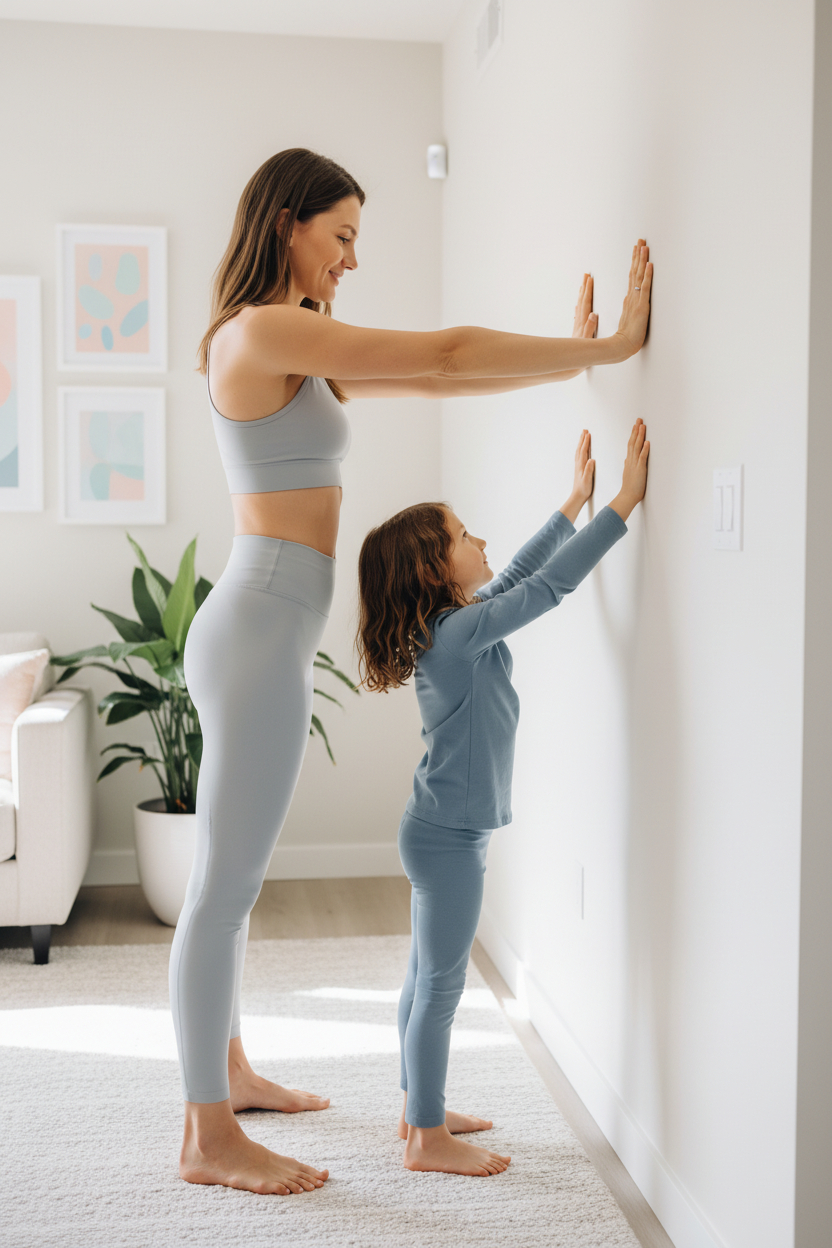
The rounded shoulders and forward head posture that so many children develop doesn't start at the neck. It starts in the upper back. The muscles between and below the shoulder blades are responsible for pulling the shoulders back and keeping the thoracic spine upright. When those muscles are weak, the upper body collapses forward, and no amount of reminding a child to "sit up straight" will fix it.
Upper back exercises kids posture programs should include are straightforward and require no equipment. As a posture specialist, I recommend six moves that target the rhomboids, lower trapezius, and posterior deltoids. These are the muscles that hold the shoulder blades in place and keep the chest open. Done 3 to 4 times a week, they can produce visible changes in a child's posture within a month.
Why the Upper Back Matters for Children's Posture
The upper back (thoracic spine) connects the neck to the lower back and anchors the shoulder blades. It's the structural center of good posture. When the muscles here are strong, the shoulders sit naturally over the hips, and the head balances easily on top of the spine. When they're weak, gravity wins. The shoulders drift forward, the chest caves in, and the head follows.
A study published in the Journal of Physical Therapy Science found that targeted upper back strengthening children received led to measurable improvements in thoracic posture within 6 weeks. The researchers noted that the mid-back muscles respond well to simple, bodyweight exercises, especially in growing children whose musculoskeletal systems adapt quickly to new movement patterns.
Children who spend hours at desks or looking at screens develop a predictable pattern: tight chest muscles, weak upper back muscles, and a forward head position that puts strain on the neck. I see this pattern in nearly every child I assess. The good news is that it responds well to consistent, targeted work. If your child shows signs of poor posture, the upper back is almost always part of the solution.
Signs That Your Child's Upper Back Needs Strengthening
Not every child with imperfect posture has a weak upper back, but most do. Here are the patterns I look for:
- Rounded shoulders that curve forward even when the child is standing relaxed.
- Shoulder blades that wing out from the back (visible through a T-shirt) instead of lying flat.
- A head that sits forward of the shoulders when viewed from the side.
- Complaints of neck or upper back stiffness after schoolwork or screen time.
- Difficulty holding a tall sitting position for more than a minute or two without slumping.
If your child shows two or more of these signs, the exercises below will address the root cause. The muscles that pull the shoulder blades together and down are simply not strong enough to hold the posture your child's skeleton is designed for. Strengthening them gives the body the support it needs to stay upright without constant effort.
6 Upper Back Exercises for Kids with Poor Posture
All of these posture exercises upper back kids can do at home are suitable for ages 5 and up. No equipment is needed. Each exercise targets the muscles between and below the shoulder blades.
1. Prone Y Raises
This exercise targets the lower trapezius, one of the most important muscles for holding the shoulder blades down and back.
- Lie face down on the floor with arms extended overhead in a Y shape, thumbs pointing up.
- Squeeze the shoulder blades together and lift both arms off the floor 2 to 3 inches.
- Hold for 3 seconds, then lower slowly.
- Repeat 8 to 10 times. Rest 30 seconds. Do 2 sets.
The key is to keep the lift small and controlled. Children tend to arch the entire back to get the arms higher. Cue them to "pull your shoulder blades into your back pockets" and keep the belly on the floor. The movement should come entirely from the upper back.
2. Wall Angels
Wall angels train the upper back to work through a full range of motion while keeping the spine aligned against a flat surface.
- Stand with the back flat against a wall, feet about 6 inches from the baseboard.
- Press the back of the head, upper back, and lower back against the wall.
- Place arms against the wall in a "goalpost" position (elbows bent 90 degrees, upper arms at shoulder height).
- Slowly slide the arms up overhead and back down, keeping everything in contact with the wall.
- Repeat 8 to 10 times. Do 2 sets.
Most children will find that their arms want to pull away from the wall as they slide up. That's the tight chest muscles resisting the movement. Over time, this exercise opens the chest and strengthens the upper back simultaneously. My 9-year-old calls these "snow angels on the wall," and she's right about the motion.
3. Seated Squeeze and Hold
A simple isometric exercise that teaches the child to feel the upper back muscles working.
- Sit on the floor with legs crossed and hands resting on the knees.
- Pull the shoulder blades together as if trying to hold a pencil between them.
- Hold for 5 seconds. Release.
- Repeat 10 times. Do 2 sets.
This exercise is especially useful for kids who sit at a desk for long periods. They can do it right at their desk without anyone noticing. A few squeeze-and-holds between assignments keeps the upper back muscles engaged and prevents the slump that builds over a school day.
4. Superman Holds
A classic back strengthening exercise that works the entire posterior chain, with emphasis on the upper back when done with the right cues.
- Lie face down with arms extended overhead.
- Lift the arms, chest, and legs off the floor simultaneously.
- Focus on squeezing the shoulder blades together at the top of the lift.
- Hold for 5 seconds. Lower down. Rest 5 seconds.
- Repeat 6 to 8 times. Do 2 sets.
Children love this one because the name makes it fun. The coaching point that matters most is the shoulder blade squeeze at the top. Without that cue, kids tend to do all the lifting from the lower back. Adding the squeeze shifts the work into the upper back where it's needed most.
5. Band-Free Reverse Fly
This exercise mimics a reverse fly without any equipment, using gravity and body position to create resistance.
- Stand with feet hip-width apart and hinge forward at the hips to about a 45-degree angle.
- Let arms hang straight down with palms facing each other.
- Keeping a slight bend in the elbows, raise both arms out to the sides until they're level with the back.
- Squeeze the shoulder blades together at the top. Hold 2 seconds.
- Lower slowly. Repeat 10 times. Do 2 sets.
The bent-over position makes the upper back work against gravity without any weights. For children under 7, I suggest starting with 5 repetitions and building up. The key is a slow, controlled motion rather than swinging the arms.
6. Cat-Cow with Shoulder Blade Focus
A modified version of the classic yoga movement that adds an upper back strengthening component.
- Start on hands and knees, wrists under shoulders, knees under hips.
- For "cow": drop the belly toward the floor, lift the chest, and actively squeeze the shoulder blades together.
- For "cat": round the back toward the ceiling, spreading the shoulder blades wide apart.
- Move slowly between the two positions, holding each for 3 seconds.
- Repeat 8 to 10 cycles. Do 2 sets.
Adding the deliberate shoulder blade squeeze during the cow position turns a flexibility exercise into a strengthening one. This combination of opening and closing the shoulder blades builds the motor control that helps children self-correct their posture throughout the day.

A Weekly Upper Back Strengthening Routine
Consistency matters more than intensity for upper back strengthening children benefit from. Here's a simple weekly plan that takes 10 to 12 minutes per session:
- Monday and Thursday: Prone Y raises + wall angels + Superman holds. About 10 minutes.
- Tuesday and Friday: Seated squeeze and hold + band-free reverse fly + cat-cow with shoulder blade focus. About 10 minutes.
- Daily mini-habit: 10 seated squeeze-and-holds at the desk between homework assignments. Takes under a minute.
According to KidsHealth, children should get at least 60 minutes of physical activity daily, and strengthening exercises should be included at least 3 days per week. Pairing these upper back exercises with core strengthening work creates a complete postural foundation.
The American Academy of Pediatrics recommends making fitness part of daily family life rather than treating it as a separate chore. I've found that children respond best when these exercises become a shared activity. My daughters and I do wall angels together most evenings. It takes 3 minutes and it's become part of our wind-down routine.
What to Expect from Upper Back Exercises
Children's muscles adapt faster than adults' muscles do. Most kids show improved shoulder blade positioning within 2 to 3 weeks of consistent practice. The visible change parents notice first is usually the shoulders sitting further back at rest. Within 4 to 6 weeks, children typically maintain better posture for longer periods without being reminded.
Pairing upper back work with reduced screen time posture habits accelerates results. The exercises build the strength; minimizing the positions that created the weakness prevents backsliding. Both pieces matter.
If your child also tends to slouch, combining these upper back exercises with the exercises in that post gives you a more complete approach. The upper back pulls the shoulders back, while the core and hip muscles support the pelvis and lower spine. Together, they address the full postural chain.
You May Also Like
- Posture Exercises for Kids at Home
- Exercises for Kids Who Slouch: A Step-by-Step Guide
- Core Exercises for Kids: Building Strength from the Inside Out
Test Your Knowledge: Upper Back Exercises for Kids
See how much you picked up from this post. Check your answers below each question.
1. Where does the rounded shoulder posture in children actually start?
a) The neck
b) The upper back, where weak muscles allow the shoulders to drift forward
c) The lower back
d) The feet
Answer: b) The upper back, where weak muscles allow the shoulders to drift forward. The muscles between the shoulder blades are responsible for holding the shoulders in their correct position.
2. What is the main coaching cue for prone Y raises?
a) Lift the arms as high as possible
b) Pull the shoulder blades together while keeping the belly on the floor
c) Arch the lower back as much as possible
d) Hold the breath during each repetition
Answer: b) Pull the shoulder blades together while keeping the belly on the floor. The lift should be small and controlled, coming from the upper back rather than the lower back.
3. Which exercise can a child do at their desk without anyone noticing?
a) Superman holds
b) Prone Y raises
c) Seated squeeze and hold
d) Wall angels
Answer: c) Seated squeeze and hold. Squeezing the shoulder blades together while sitting requires no visible movement and can be done at any desk.
4. How often should children do upper back strengthening exercises?
a) Once a month
b) 3 to 4 times a week
c) Every hour
d) Only when they have back pain
Answer: b) 3 to 4 times a week. Consistent, moderate practice produces better results than infrequent intense sessions.
5. When can parents typically expect to see improved shoulder positioning?
a) After 1 session
b) 2 to 3 weeks of consistent practice
c) 6 months
d) Only with professional intervention
Answer: b) 2 to 3 weeks of consistent practice. Children's muscles adapt quickly. Improved shoulder blade positioning is usually the first visible change parents notice.
A Full Program Built Around These Exercises
Upper back strength is one component of a complete posture correction approach. My Posture and Feet course includes video-guided exercises for the upper back, core, hips, and feet, organized into a progressive plan that builds strength and alignment from the ground up.
Strong upper back muscles give the shoulders a place to rest. When the whole chain is addressed together, the improvements hold.