How to Start a Daily Movement Habit with Your Kids
- Juliana Lucky

- May 7
- 7 min read
Getting kids to move is not the hard part. The hard part is making movement happen every single day without it turning into a negotiation, a chore, or something that gets pushed aside by homework and screens. A daily movement habit kids actually maintain requires something different from a workout plan. It requires a system that fits into the life your family already has.
My family has had a daily movement routine for over three years. It isn't always the same exercises. It isn't always the same time of day. But it happens every day because we built it into our life rather than adding it on top of an already full schedule. Here's the framework that made it stick, and how you can adapt it for your family.
Why Daily Movement Matters More Than Structured Exercise
The CDC recommends that children ages 6 to 17 get at least 60 minutes of moderate-to-vigorous physical activity every day. That sounds like a lot, but it doesn't need to come from a single structured session. Movement spread throughout the day counts, and for most families, that's a more realistic and sustainable approach.
The difference between a daily movement habit kids build over time and a structured exercise program is consistency versus intensity. A 10-minute movement session that happens every morning without fail does more for posture, flexibility, and overall health than a 45-minute gymnastics class that happens twice a week and nothing in between. The body adapts to what it does regularly, not what it does occasionally.
I see this clearly in the children I work with. The ones who do a little bit every day, even just 5 to 10 minutes, show faster and more lasting improvements than the ones who do longer sessions sporadically. Their muscles stay engaged, their flexibility holds, and their posture becomes a default rather than something they have to think about.

The 3-Anchor Framework for Building a Kids Movement Routine Daily
The system that works for our family (and the families I coach) is built around three anchors: moments in the day that are already fixed and consistent. You attach movement to those anchors, and it becomes automatic. No willpower required.
Anchor 1: The Morning Transition
Every child has a gap between waking up and leaving for school (or starting the school day at home). That gap is your first anchor. A morning movement routine of 5 to 7 minutes is enough to wake up the body, activate the postural muscles, and set the tone for the day.
In our house, this looks like 3 to 4 simple exercises done in the living room before breakfast. My girls know the routine: cat-cow stretches, 10 jumping jacks, a 30-second balance hold, and a forward fold. The whole thing takes under 5 minutes. We've done it so many mornings that they start without being asked.
Anchor 2: The After-School Reset
The transition from school to home is the second anchor. After sitting for hours, children's bodies need a physical reset before they sit down again for homework or screens. This is the best time for active, energetic movement: running in the yard, a dance break, obstacle courses, or any activity that gets the heart rate up.
This anchor can be flexible. Some days it's 20 minutes of outdoor play. Other days it's 10 minutes of building exercise habit children enjoy, like animal walks across the living room or a quick game of freeze tag. The point is that something physical happens between school and the evening routine. The American Academy of Pediatrics recommends making fitness a family habit rather than an isolated activity, and the after-school window is the perfect time for that.
Anchor 3: The Evening Wind-Down
The third anchor is the transition between the active evening and bedtime. Gentle stretching, yoga poses, or posture exercises done in the last 30 minutes before bed serve two purposes: they maintain flexibility and they help the child's nervous system shift into rest mode.
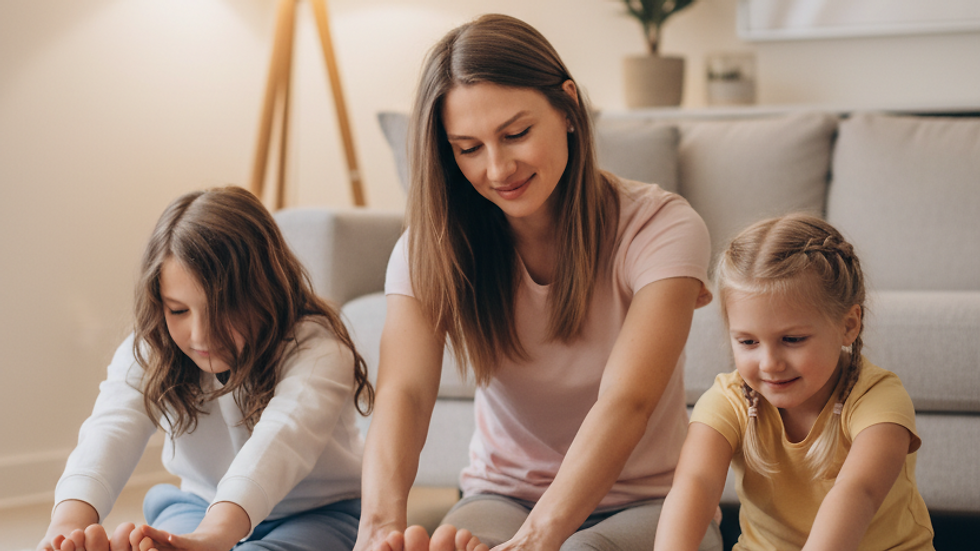
This is the anchor my daughters look forward to most. We do it together on the living room rug while talking about the day. It's 5 minutes of stretching that doubles as connection time. When movement feels like a shared moment rather than a task, children stop resisting it.
Making the Daily Movement Habit Stick
Knowing the framework is the easy part. Making it last through busy weeks, bad moods, and schedule disruptions is where most families struggle. Here are the strategies that keep it working:
Start Smaller Than You Think
When families tell me they tried a movement routine and it didn't stick, I always ask how long it was. The answer is usually 15 to 20 minutes. That's too long to start with. Begin with 3 to 5 minutes. Once the habit is automatic (usually after 2 to 3 weeks), you can gradually extend it. A 3-minute routine that happens every day builds more momentum than a 15-minute routine that lasts a week.
Let Kids Choose Some of the Movements
Autonomy drives engagement. Give your child 2 to 3 options for each movement slot and let them pick. "Do you want to do jumping jacks, high knees, or bear crawls?" The movement still happens; the child just gets a say in what it looks like. I keep a short list of options on the fridge so my girls can point to what they want that day.
Track It Visually
A simple wall calendar with a sticker for each day the movement routine happens works better than any app. Children are motivated by visible progress. After a week of stickers, they don't want to break the chain. This approach works especially well for kids ages 4 to 9.
Do It Together
Children mirror what they see. If you're sitting on the couch telling them to stretch, the message is "movement is something I make you do." If you're on the rug stretching beside them, the message is "movement is something our family does." I cannot overstate how much this single change matters. My own family exercise routine works because every person in the house participates.
What a Daily Movement Habit Looks Like in Practice
Here's a sample week from our family. It's not rigid. It changes based on energy levels, weather, and schedules. But the three anchors always happen:
Morning (5 minutes): Cat-cow, 10 jumping jacks, 30-second single-leg balance, standing forward fold.
After school (10 to 20 minutes): Monday: bike ride. Tuesday: backyard obstacle course. Wednesday: dance party. Thursday: playground. Friday: animal walk races in the house.
Evening (5 minutes): Butterfly stretch, supine hamstring stretch, child's pose, 5 deep breaths in a seated position.
The total daily movement time ranges from 20 to 30 minutes, split across three moments. None of them feel long. None of them require special equipment or driving anywhere. And because they're attached to transitions that already happen, they don't compete with homework, meals, or free time.
According to KidsHealth, the best exercise for kids is whatever gets them moving and having fun. The daily habit approach works because it removes the pressure of finding one big block of time and replaces it with small, enjoyable moments scattered throughout the day.

What to Do When Kids Resist the Movement Routine
Resistance is normal, especially in the first two weeks. Here's how I handle it without turning movement into a power struggle:
On low-energy days: Shorten the routine to 2 minutes. Two minutes of stretching is infinitely better than zero minutes. The goal is to keep the habit alive, not to hit a performance target.
When a child says no: Start doing the routine yourself. In my experience, a child who refused to join will wander over within 60 seconds once they see a parent on the floor doing something interesting.
For younger kids (ages 3 to 5): Make it a game. "Can you be a frog and jump to the kitchen?" "Let's be flamingos and stand on one foot." Movement disguised as play doesn't feel like exercise.
For older kids (ages 8 to 12): Give them ownership. Let them design the routine, time it with a stopwatch, or teach a younger sibling. Responsibility increases buy-in. Tips on getting kids to exercise daily cover more strategies for this age group.
The most important thing is that the routine never becomes punishment or obligation. If a child associates movement with stress, they'll avoid it for years. Keep it light. Keep it short. Keep showing up.
You May Also Like
Test Your Knowledge: Daily Movement Habits for Kids
See how much you picked up from this post. Check your answers below each question.
1. How much daily physical activity does the CDC recommend for children ages 6 to 17?
a) 20 minutes
b) 30 minutes
c) 60 minutes
d) 90 minutes
Answer: c) 60 minutes. This can be spread throughout the day and doesn't need to come from a single session.
2. What are the three anchors in the daily movement framework?
a) Breakfast, lunch, and dinner
b) Morning transition, after-school reset, and evening wind-down
c) Before school, during school, and after school
d) Warm-up, workout, and cool-down
Answer: b) Morning transition, after-school reset, and evening wind-down. These are moments already fixed in the daily schedule, making them natural attachment points for movement.
3. How long should a starting movement routine be?
a) 30 minutes
b) 20 minutes
c) 3 to 5 minutes
d) At least 45 minutes
Answer: c) 3 to 5 minutes. Starting small makes the habit automatic. You can gradually extend it after 2 to 3 weeks.
4. What is the single most effective strategy for getting kids to move daily?
a) Offering rewards for each completed session
b) Doing the routine together as a family
c) Making it mandatory with consequences
d) Signing up for organized sports
Answer: b) Doing the routine together as a family. When children see parents participating, the message shifts from "something I make you do" to "something our family does."
5. What should you do on days when your child refuses to participate?
a) Skip the routine entirely
b) Force them to complete the full routine
c) Start doing the routine yourself; they usually join within a minute
d) Double the routine the next day to make up for it
Answer: c) Start doing the routine yourself; they usually join within a minute. Children are naturally curious. Modeling the behavior is more effective than insisting on it.
More Movement, Better Posture
A daily movement habit creates the foundation. For families ready for a structured, progressive approach to posture and alignment, my Posture and Feet course provides video-guided routines that fit naturally into the anchor points described above.
Small daily investments in movement add up. The children who move a little every day are the ones who stand tallest and feel strongest over time.






Comments