Best Backpack Habits for Kids with Back or Posture Pain
- Juliana Lucky

- Jan 22
- 8 min read
Every fall, I watch kids walk into school leaning forward under backpacks that weigh nearly as much as a small dog. Their shoulders round, their chins jut out, and their lower backs arch to compensate. As a posture correction specialist and a mom of two, I see the effects of heavy, poorly worn backpacks on children's spines every single day in my practice.
The good news: most backpack-related posture problems are fixable with a few simple habit changes. You do not need to buy an expensive ergonomic pack or limit your child to one textbook at a time. What matters most is how the best backpack for kids posture fits, how much it weighs relative to your child's body, and how your child wears it throughout the day.
In this post, I will walk you through the weight limits pediatric experts recommend, the strap and fit adjustments that make the biggest difference, and the daily packing habits that keep your child's back healthy all school year.
How Heavy Backpacks Affect a Child's Posture
A backpack that is too heavy forces a child to lean forward at the hips to stay balanced. This forward lean compresses the spine, tightens the chest muscles, and pulls the shoulders into a rounded position. Over weeks and months of this pattern, the muscles in the upper back weaken while the front of the body gets shorter and tighter.
Research from the American Academy of Pediatrics confirms that carrying loads above the recommended limit changes the way children walk and stand. One study published in the journal Spine found that children carrying backpacks at 15% or more of their body weight showed measurable changes in trunk posture and gait. These are not permanent injuries in most cases, but they are signals that the load is too much.
I see this pattern often in my practice. A parent brings in a 9-year-old for slouching, and when I ask about the daily routine, the backpack is one of the first things I check. Many kids are carrying 18 to 22 pounds on their backs five days a week. For a child who weighs 65 pounds, that is over 30% of their body weight. No adult would do that without consequences, and neither should a child.
The signs are easy to spot once you know what to look for. If your child leans forward when walking with a backpack, complains of neck or shoulder pain after school, or has red marks on their shoulders from the straps, the pack is too heavy, too loose, or both.

Backpack Weight Limit for Children: What Experts Recommend
The most widely cited guideline comes from the American Academy of Pediatrics: a child's backpack should weigh no more than 10 to 20% of their body weight. Many orthopedic specialists, including those at the Cleveland Clinic, recommend staying closer to 10% for younger children and allowing up to 15% for teenagers with stronger core muscles.
Here is what the backpack weight limit for children looks like in practice:
A 50-pound first grader should carry no more than 5 to 7.5 pounds.
A 75-pound fourth grader can handle 7.5 to 11 pounds.
A 100-pound seventh grader should stay under 10 to 15 pounds.
A 130-pound high schooler should cap the load at 13 to 19 pounds.
I recommend weighing your child's packed backpack at home using a bathroom scale. Pick it up while standing on the scale, then subtract your own weight. Many parents are surprised by the result. Textbooks, water bottles, lunch boxes, and that random collection of rocks from recess add up fast.
If the pack regularly exceeds 15% of your child's body weight, it is time to either lighten the load or look at how the weight is distributed. Distribution matters just as much as total weight, which brings me to the next section.
Best Backpack Fit and Strap Adjustments for Kids Posture
The best backpack for kids posture is not necessarily the most expensive one. It is the one that fits correctly and is adjusted properly every time your child puts it on. Here are the fit points I check with every family in my practice.
Shoulder Straps
Both straps should be used at all times. Wearing the pack over one shoulder doubles the load on that side, forcing the spine to curve laterally. The straps should be wide and padded, sitting flat against the shoulders without digging in. Tighten them until the pack sits snug against the back with no gap. If the bag sways or bounces when your child walks, the straps are too loose.
Chest and Waist Straps
If the backpack has a chest strap (also called a sternum strap), use it. This strap keeps the shoulder straps from sliding outward and distributes weight more evenly across the torso. A waist or hip belt is even better, especially for heavier loads, because it transfers weight from the shoulders to the hips. This is the same principle used in hiking packs for adults.
Back Panel and Pack Height
The back of the pack should have some padding. The bottom of the backpack should rest at the waist, not hanging below the hips. The top should sit no higher than the shoulders. If the pack hangs past the hips, it pulls the child backward and they compensate by leaning forward. A pack that rides too high pushes the child's head forward.
I tell parents to think of the backpack as part of their child's outfit. Just like you would adjust a helmet to fit right, the backpack straps need checking every few weeks as your child grows.

Smart Packing Habits That Protect Your Child's Back
How your child packs the bag matters as much as how they wear it. A 10-pound backpack with all the weight at the bottom will pull differently than one packed with heavy items against the back and lighter items at the front.
Pack Heavy Items Close to the Back
Textbooks, laptops, and binders should sit in the compartment closest to your child's spine. This keeps the center of gravity closer to the body and reduces the forward pull. Lighter items like pencil cases, snacks, and folders go in the outer pockets.
Use All the Compartments
Many kids toss everything into the main pocket. This creates a heavy, unbalanced lump that shifts as they walk. Teach your child to use the front pocket, side pockets, and any organizer sections. Spreading the load out keeps it stable.
Do a Weekly Cleanout
Kids accumulate things. Old papers, extra snack wrappers, toys, library books they forgot to return. I do a backpack cleanout every Sunday evening with both my kids (ages 5 and 9). We pull everything out, toss what does not belong, and pack only what is needed for Monday. This alone can cut 2 to 4 pounds from a typical backpack.
If your child's school allows it, keeping a second set of heavy textbooks at home can also make a big difference. Some schools offer digital versions of textbooks, which is worth asking about at the start of the year.

Posture Red Flags to Watch for During the School Year
Even with the best backpack habits, kids spend long hours sitting in classrooms, looking down at desks, and hunching over tablets. The backpack is one piece of the posture puzzle. If you notice ongoing posture changes, the backpack may not be the only factor.
Watch for these signs:
Rounded shoulders that persist even when the pack is off
Frequent complaints of upper back or neck pain
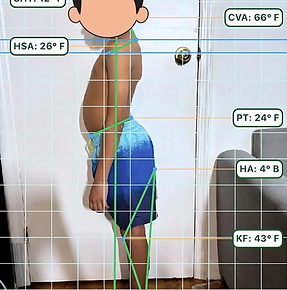
A head that seems to sit forward of the shoulders when viewed from the side
Uneven shoulder height when standing naturally
Reluctance to sit up straight or complaints of fatigue when sitting
These signs do not mean something is seriously wrong. They usually mean the muscles are out of balance, with some too tight and others too weak. Targeted movement and posture habits can address most of these patterns, especially when caught early.
I wrote about these warning signs in detail in my post on signs of poor posture in children, which includes a visual checklist you can use at home. If your child also spends a lot of time on screens, my guide on screen time and posture covers the connection between devices and forward head posture.
Simple Exercises to Counter Backpack Strain
A few minutes of targeted stretching and strengthening after school can undo the effects of a heavy pack. These are moves I recommend to parents in my practice, and they work well for kids ages 5 through 14.
Wall Angels: Have your child stand with their back flat against a wall, arms out to the sides at shoulder height with elbows bent at 90 degrees. Slowly slide the arms up above the head and back down, keeping the back, elbows, and wrists touching the wall the entire time. Do 8 to 10 repetitions. This opens the chest and activates the upper back muscles that get compressed by heavy straps.
Chin Tucks: Standing or sitting tall, have your child pull their chin straight back (making a "double chin") and hold for 5 seconds. Release and repeat 10 times. This counteracts the forward head position caused by leaning under a heavy pack.
Cat-Cow Stretch: On hands and knees, alternate between arching the back up (cat) and dropping the belly down with the head lifting (cow). Move slowly through 8 to 10 cycles. This mobilizes the entire spine and relieves compression from carrying weight.
Bridge Holds: Lying on the back with knees bent and feet flat, lift the hips toward the ceiling and hold for 10 to 15 seconds. Repeat 5 times. This strengthens the glutes and lower back, both of which support the spine during backpack carrying.
These take about 5 minutes total. I have my own kids do them after school three to four days a week, and the difference in how they hold their shoulders is noticeable within a couple of weeks.
You May Also Like
If your child's posture concerns go beyond the backpack, these posts offer practical next steps:
7 Posture Exercises Kids Can Do at Home in 10 Minutes: a quick daily routine for stronger posture muscles.
Signs of Poor Posture in Children: What Parents Should Look For: a visual guide to spotting posture changes early.
Exercises for Kids Who Slouch: A Posture Specialist's Guide: targeted moves for children who round their shoulders or hunch forward.
Quick Quiz: Test Your Backpack Knowledge
1. What percentage of a child's body weight should a backpack weigh at most?
A) 25 to 30%
B) 10 to 20%
C) 30 to 40%
D) 5% or less
Answer: B) 10 to 20%
2. Where should the heaviest items be placed inside a backpack?
A) In the front outer pocket
B) At the bottom of the main compartment
C) In the compartment closest to the child's back
D) In the side pockets
Answer: C) In the compartment closest to the child's back
3. What is the purpose of a chest (sternum) strap on a backpack?
A) To make the backpack look sporty
B) To keep the shoulder straps from sliding and distribute weight evenly
C) To prevent the backpack from being stolen
D) To hold a water bottle in place
Answer: B) To keep the shoulder straps from sliding and distribute weight evenly
4. Which of these is a sign that a child's backpack may be too heavy?
A) The child walks upright with no trouble
B) The child leans forward while walking with the pack on
C) The straps sit flat on the shoulders
D) The child does not complain about the backpack
Answer: B) The child leans forward while walking with the pack on
5. How often should parents do a backpack cleanout with their child?
A) Once a semester
B) Every day
C) Once a week
D) Only at the end of the school year
Answer: C) Once a week
A Structured Approach to Better Posture Habits
Fixing a backpack fit takes five minutes. Building lasting posture habits takes a bit longer. If you are looking for a step-by-step program that strengthens your child's posture from the ground up, my Posture and Feet course gives you video-guided exercises designed for kids ages 2 through 12. It covers everything from foot alignment to upper back strength, so the backpack is just one part of the full picture.




Comments