How to Strengthen Your Child's Feet with Simple Daily Exercises
- Juliana Lucky

- Sep 23, 2025
- 7 min read
Most parents pay close attention to their child's teeth, vision, and growth charts. But how often do we think about the muscles in their feet? I work with families every week who are surprised to learn that foot strength plays a direct role in posture, balance, and even knee alignment. The good news is that learning how to strengthen kids feet takes just a few minutes a day, and the exercises feel more like play than work.
In this post, I will walk you through practical foot strengthening exercises your child can start today. These are moves I use with my own kids (ages 5 and 9) and recommend to the families I work with as a posture and alignment specialist.
Why Foot Strength Matters More Than You Think
Children's feet contain 26 bones, 33 joints, and over 100 muscles, tendons, and ligaments. According to the American Academy of Pediatrics, foot development continues well into the school-age years. That means the habits your child builds now directly shape how their feet function as they grow.
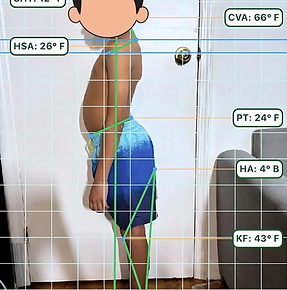
Weak foot muscles can lead to flat arches, turned-in ankles, and difficulty with balance. Over time, these patterns may affect the knees, hips, and lower back. I see this connection regularly in my practice. A child comes in for knock knees or postural concerns, and when I look at their feet, the weakness is obvious.
Strong feet act as a stable foundation for the entire body. When the small muscles of the foot activate properly, they support the arch, absorb impact during running and jumping, and help the ankles stay aligned. That is why foot strengthening exercises for kids deserve the same attention as any other part of physical development.
The modern factor worth mentioning is footwear. Many children spend their days in rigid, cushioned shoes that do the work their foot muscles should be doing. A study published in Frontiers in Pediatrics found that children who spent more time barefoot had stronger, more flexible feet than those who wore shoes most of the day. I am not saying shoes are bad. But giving your child regular opportunities to go barefoot on safe surfaces is one of the easiest ways to build foot strength naturally.
Signs Your Child May Need Foot Strengthening
Before jumping into exercises, it helps to know what to look for. These are some common signs that a child's foot muscles could use more attention.
They complain about tired or achy feet after moderate activity.
They avoid running or active play because their feet hurt.
Their ankles roll inward when they stand or walk (this is sometimes called pronation).
They have visibly flat arches when standing.
They trip or lose balance more often than expected for their age.
They prefer to sit rather than stand during activities.
If you notice one or more of these patterns, targeted foot exercises can make a real difference. And even if your child's feet seem fine, these exercises are a smart preventive habit. For a personalized assessment of your child's foot and posture patterns, you can also book a personal diagnostic.
Six Daily Exercises to Strengthen Your Child's Foot Arches
These exercises target the intrinsic muscles of the foot, the small muscles that control arch shape and toe movement. I recommend doing three to four of these per session, rotating through all six over the course of a week. Each one takes about two minutes.
Towel Scrunches
Place a thin towel flat on a hard floor. Have your child stand at one end with bare feet. Using only their toes, they scrunch the towel toward them, pulling it underneath their foot bit by bit. Once the whole towel is bunched up, they spread it back out and repeat. Aim for three rounds per foot.
This exercise targets the toe flexors and the muscles that support the arch. Most kids find it satisfying once they get the hang of it, like a little foot puzzle.
Marble Pickups
Scatter 10 to 15 marbles (or small pom-poms for younger children) on the floor next to a small bowl. Your child picks up one marble at a time using only their toes and drops it into the bowl. Alternate feet halfway through.
This builds grip strength in the toes and activates the deep muscles along the bottom of the foot. It also improves coordination between the brain and foot, which is something many kids rarely practice.
Heel Raises with a Slow Lower
Have your child stand on a flat surface with feet hip-width apart. They rise up onto their tiptoes as high as they can, hold for two seconds, then lower back down slowly over a count of three. Repeat 10 to 12 times.
The slow lowering is the key part. It builds eccentric strength in the calf and the muscles along the bottom of the foot. If your child needs support, they can lightly hold a wall or chair.
Single-Leg Balance Hold
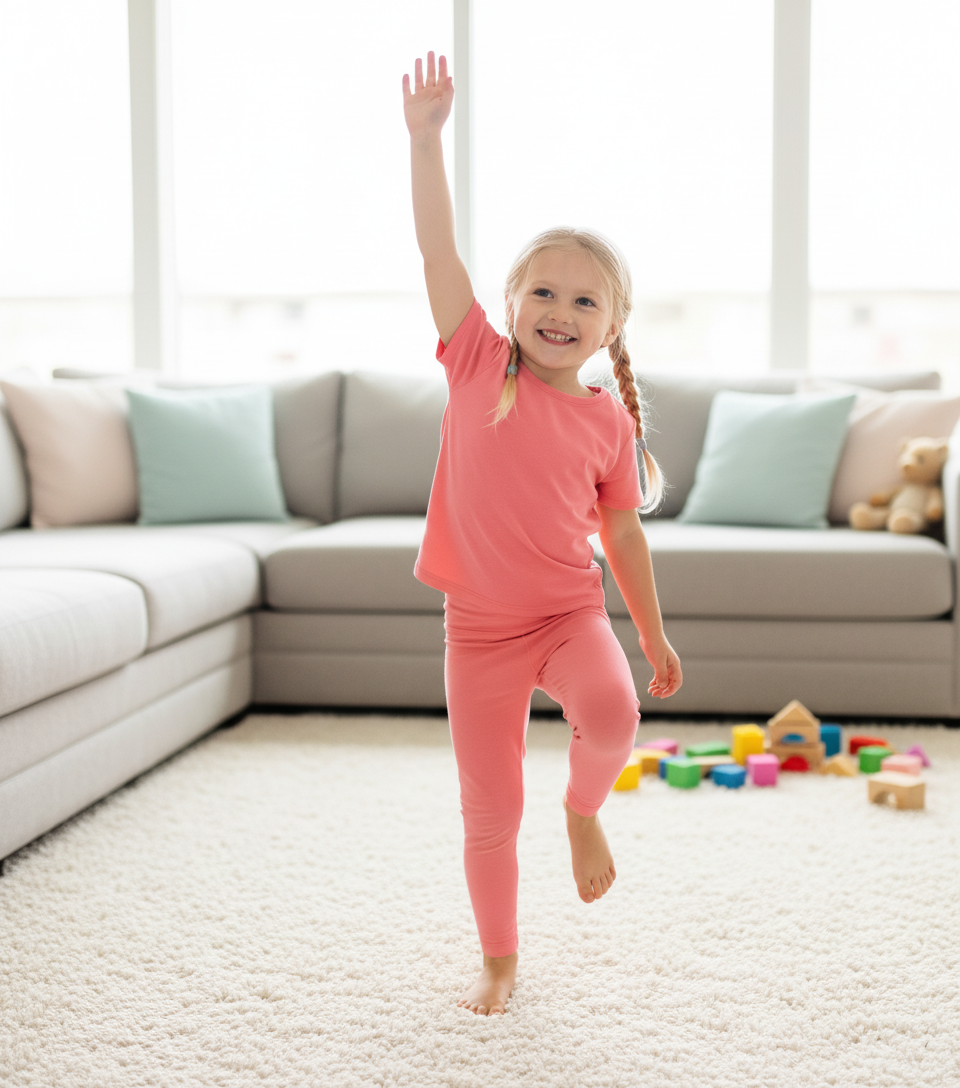
Your child stands on one foot with their arms out to the sides. The goal is to hold steady for 15 to 30 seconds, then switch feet. To make it more interesting, have them close their eyes for the last five seconds or toss a soft ball back and forth while balancing.
This exercise trains the small stabilizer muscles in the foot and ankle. Those stabilizers fire constantly during walking and running, but they only get stronger when challenged with balance work.
Toe Spreads and Lifts
Your child sits in a chair with bare feet flat on the floor. First, they try to spread all five toes apart as wide as possible, hold for three seconds, then relax. Next, they lift only their big toe while keeping the other four down, then reverse it by lifting the four small toes while pressing the big toe down.
This one is tricky. Most children (and many adults) struggle with independent toe control at first. That is completely normal. With practice over a few weeks, the neural pathways develop and it becomes easier. These muscles are directly involved in arch support and push-off during walking.
Arch Doming (Short Foot Exercise)
Your child sits or stands with their foot flat on the floor. Without curling the toes, they try to shorten the foot by drawing the ball of the foot toward the heel, creating a higher arch. Hold for five seconds, relax, and repeat eight times per foot.
This exercise, sometimes called the "short foot" exercise, specifically targets the intrinsic foot muscles responsible for maintaining arch height. It takes some coaching at first. I usually tell kids to imagine they are trying to pick up the floor with the middle of their foot.
How to Make Foot Exercises a Daily Habit
The biggest challenge with children's exercises is not the exercises themselves. It is consistency. Here are strategies I have found effective with my own family and with the families in my Posture and Feet course.
Attach exercises to an existing routine. The easiest time is right after bath when feet are already bare. Morning wake-up is another natural window. By linking the exercises to something your child already does, you remove the friction of starting from scratch.
Keep sessions short. Five minutes is plenty for younger children. Seven to ten minutes works for kids ages 7 and up. Longer sessions lead to boredom, and boredom leads to quitting.
Use a visual tracker. A simple chart on the fridge where your child puts a sticker after each session can be surprisingly motivating for kids under 8. Older children might prefer a checklist they can cross off.
Rotate the exercises. Doing the same two moves every day gets stale fast. Cycle through all six exercises over the week so each session feels slightly different.
Do the exercises with your child. This is the most effective strategy I know. When I do heel raises and towel scrunches alongside my kids, they stay engaged twice as long. It also gives me a chance to check their form and make small corrections.
When Foot Strengthening Exercises for Kids Are Not Enough
Foot strengthening exercises work well for mild weakness, developing arches, and general prevention. But there are situations where exercises alone are not sufficient.
If your child's feet show significant inward rolling that does not improve after six to eight weeks of consistent practice, it is worth getting a professional evaluation. The same applies if they have pain that limits activity or if one foot looks noticeably different from the other.
In my experience, most children respond well to regular foot work combined with appropriate footwear choices. I cover footwear in detail in my Ultimate Footwear Guide, which breaks down what to look for in children's shoes at every age. The short version: look for flexible soles, a wide toe box, and minimal heel elevation.
If your child also deals with flat arches, you might find my post on flat feet exercises for kids helpful. It covers arch-specific movements in more depth. And if knock knees are part of the picture, my guide to knock knees exercises for kids has targeted moves for that pattern too.
You May Also Like
Flat feet exercises kids actually enjoy doing covers arch-specific exercises and when flat feet in children need attention versus when they are part of normal development.
Knock knees exercises for kids to try at home explains the connection between foot position and knee alignment, with exercises that address both.
Test Your Knowledge: Kids Foot Strength
1. How many bones are in a child's foot?
A) 12 B) 26 C) 33 D) 40
Answer: B) 26
2. What is the main benefit of the "slow lower" during heel raises?
A) It stretches the hamstrings B) It builds eccentric strength in the foot and calf C) It improves flexibility in the toes D) It strengthens the hip muscles
Answer: B) It builds eccentric strength in the foot and calf
3. Which exercise specifically targets independent toe control?
A) Towel scrunches B) Single-leg balance C) Toe spreads and lifts D) Marble pickups
Answer: C) Toe spreads and lifts
4. What is the recommended session length for children under 7?
A) 15 minutes B) 10 minutes C) 5 minutes D) 20 minutes
Answer: C) 5 minutes
5. What does the "short foot" exercise train?
A) Calf muscles B) Ankle flexibility C) Intrinsic foot muscles for arch support D) Hip stabilizers
Answer: C) Intrinsic foot muscles for arch support
A Full Program Built Around These Exercises
If you want a structured, video-guided approach to strengthening your child's feet and improving their posture, my Posture and Feet course walks you through it step by step. It includes age-appropriate progressions and a schedule that takes the guesswork out of what to do each day.
Strong feet are not built overnight, but they are built with small, consistent effort. A few minutes of focused practice each day gives your child a foundation that supports every step they take.






Comments