7 Posture Exercises Kids Can Do at Home in 10 Minutes
- Juliana Lucky

- Jun 19, 2025
- 7 min read
Most kids spend hours sitting each day, whether at school, doing homework, or watching screens. Over time, those sitting hours can lead to rounded shoulders, a forward head position, and a general lack of body awareness. The good news: posture exercises for kids at home take less than 10 minutes and can make a real difference. In this post, I'm sharing seven of my favorite exercises that I use with my own kids and recommend to the families I work with. Each one is simple, requires no equipment, and is easy enough for children as young as four.
Why Posture Exercises for Kids at Home Actually Work
Children's bodies are incredibly adaptable. Their muscles and bones are still developing, which means targeted movement can have a meaningful effect on alignment. A study published by the National Institutes of Health confirms that age-appropriate physical activity supports musculoskeletal development in children. The key is consistency.
Short, daily practice trains the muscles that support good posture, specifically the core, upper back, and glutes. I've seen children in my practice show visible improvement in just four to six weeks of regular exercise. These aren't complicated gym routines. They're playful, quick movements that fit into any family's morning or after-school schedule.
How to Get the Most Out of These Exercises
Before jumping into the exercises, here are a few tips to set your child up for success. First, pick a consistent time. Morning works well because the body is fresh and it builds a habit before the day gets busy. Second, keep it light. These should feel like play, not punishment.
I often tell parents to do the exercises alongside their kids, which makes it more fun for everyone. Third, aim for five days a week. Consistency matters more than perfection. If your child skips a day, just pick it up again the next morning.
Each exercise below includes the number of reps and sets I recommend. Adjust as needed based on your child's age and comfort level.

Exercise 1: Wall Angels
This exercise targets the upper back and shoulder muscles that pull the shoulders back into alignment. Have your child stand with their back flat against a wall, feet about six inches away from the base. Their head, upper back, and hips should all touch the wall.
Ask them to raise both arms to shoulder height, bend the elbows to 90 degrees (like a goalpost shape), and press the backs of their hands against the wall. From here, they slowly slide their arms up overhead, keeping contact with the wall, then back down to the starting position. This movement strengthens the muscles between the shoulder blades and opens up the chest.
Do 8 to 10 repetitions for 2 sets, resting 30 seconds between sets.
Exercise 2: Cat-Cow Stretch
This classic movement improves spinal flexibility and teaches kids to feel the difference between a rounded back and an arched one. Your child starts on all fours with hands under shoulders and knees under hips. For the cow position, they drop the belly toward the floor and lift the head gently. For the cat position, they round the back up like a stretching cat and tuck the chin toward the chest.
I encourage kids to move slowly and breathe with each position: inhale on the cow, exhale on the cat. This builds body awareness, which is one of the most overlooked parts of posture correction exercises for kids.
Do 8 repetitions (one cat plus one cow equals one rep) for 2 sets.
Exercise 3: Superman Hold
The superman hold builds strength in the lower back, glutes, and upper back, all of which are essential for an upright posture. Your child lies face down on a mat or soft surface with arms extended overhead. On your cue, they lift their arms, chest, and legs off the ground at the same time, holding the position for 3 to 5 seconds. Then they lower back down.
The key is to keep the neck in a neutral position by looking at the floor rather than craning up. If your child finds it too difficult at first, they can start by lifting just the arms or just the legs.
Do 6 to 8 repetitions for 2 sets, with a brief rest between sets.

Exercise 4: Chest Opener Stretch
Kids who spend a lot of time hunched over tablets or desks tend to develop tight chest muscles. This stretch counteracts that tightness. Your child stands tall and clasps both hands behind their back. They gently straighten the arms and lift the hands away from the body while squeezing the shoulder blades together.
They should feel a stretch across the front of the chest and the fronts of the shoulders. Hold for 15 to 20 seconds, release, and repeat 3 times. According to the American Academy of Pediatrics, regular stretching helps maintain joint range of motion and supports healthy growth patterns in school-age children.
I recommend doing this one after any long sitting period, like homework or screen time.
Exercise 5: Single-Leg Balance
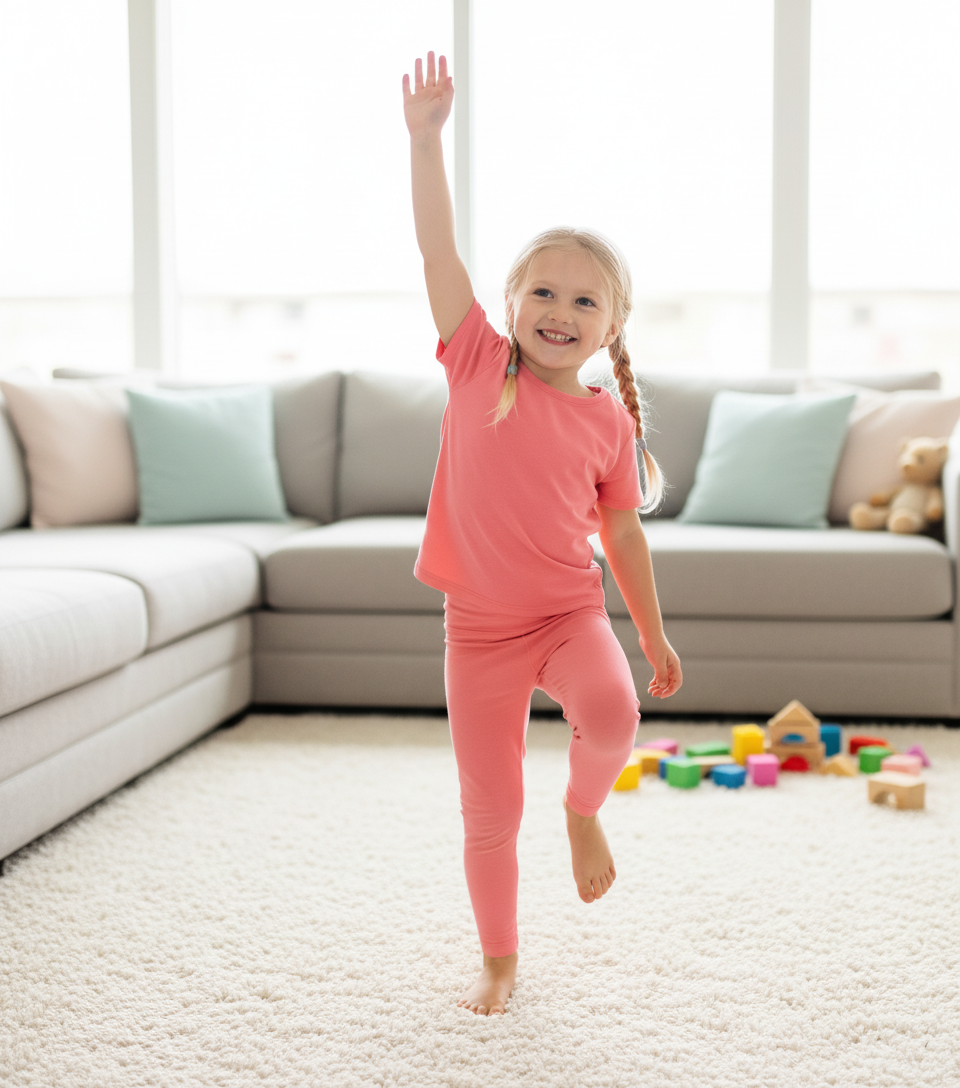
Balance is directly connected to posture. Children who can balance well tend to have stronger core muscles and better body control. For this exercise, your child stands on one foot with the other foot lifted slightly off the ground. Arms can be out to the sides for stability. They hold for 15 to 30 seconds, then switch legs.
To make it more fun, I have kids try closing their eyes for a few seconds while balancing (with a parent nearby for safety). Older kids can try standing on a pillow or folded towel for an extra challenge.
Do 3 holds on each leg. This is a great exercise for how to fix child's posture because it trains the stabilizing muscles that keep the spine aligned during standing and walking.
Exercise 6: Bridge Lifts
Weak glutes contribute to a forward-tilting pelvis, which cascades into lower back rounding and poor overall posture. Bridge lifts target the glutes and hamstrings while gently engaging the core. Your child lies on their back with knees bent and feet flat on the floor, hip-width apart.
They press through the heels to lift the hips toward the ceiling, squeezing the glutes at the top, then slowly lower back down. Each rep should take about 3 to 4 seconds up and 3 to 4 seconds down for maximum benefit.
Do 10 to 12 repetitions for 2 sets. My kids enjoy counting their reps out loud, which keeps them focused and makes it feel more like a game.
Exercise 7: Chin Tucks
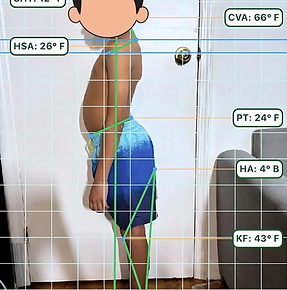
Forward head posture is common in children who use phones or tablets regularly. Chin tucks strengthen the deep neck flexors that pull the head back into proper alignment over the spine. Your child sits or stands tall and gently draws the chin straight back, creating a "double chin" effect. They hold for 5 seconds, then release.
The movement is small but precise. I remind kids to imagine they're a turtle pulling their head into a shell. This visual cue helps them get the movement right without straining.
Do 8 to 10 repetitions for 2 sets. This is one of the most effective fun posture exercises for kids because it directly addresses one of the most common alignment issues I see in my practice.

Putting It All Together: A Simple Daily Routine
If seven exercises feel like a lot, start with three or four and rotate through the full set over the week. A solid 10-minute routine could look like this: wall angels, cat-cow stretch, superman hold, and chin tucks on Monday, Wednesday, and Friday. Then swap in chest opener stretch, single-leg balance, and bridge lifts on Tuesday and Thursday.
Within a few weeks, most kids can do all seven in a single session. The Children's Hospital of Philadelphia recommends that kids get at least 60 minutes of physical activity daily, and these posture exercises for kids at home can be a structured part of that daily movement. Building this habit early sets the foundation for better alignment as your child grows.
You May Also Like
If you found these posture exercises helpful, you might also enjoy these related posts. For children with flat feet, check out my article on 5 Flat Feet Exercises Kids Actually Enjoy Doing, which covers targeted foot-strengthening movements.
If your child shows signs of knee misalignment, my post on 6 Knock Knees Exercises for Kids to Try at Home offers specific exercises for that area. And for a broader look at why early intervention matters, I wrote about 6 Critical Reasons to Address Posture and Alignment Issues Early.
Quiz: Test Your Knowledge on Kids' Posture Exercises
Question 1: How many days per week should children ideally do posture exercises?
A) One day per week B) Two to three days per week C) Five days per week D) Only when they complain about back pain
Answer: C) Five days per week. Consistency is more effective than occasional intense sessions.
Question 2: Which exercise specifically targets forward head posture?
A) Bridge lifts B) Cat-cow stretch C) Chin tucks D) Wall angels
Answer: C) Chin tucks. They strengthen the deep neck flexors that pull the head back over the spine.
Question 3: What is the recommended hold time for the superman exercise?
A) 1 second B) 3 to 5 seconds C) 30 seconds D) 60 seconds
Answer: B) 3 to 5 seconds per repetition with controlled form.
Question 4: Why is single-leg balance connected to posture?
A) It stretches the hamstrings B) It strengthens core and stabilizing muscles C) It increases flexibility in the spine D) It builds upper body strength
Answer: B) It strengthens core and stabilizing muscles that keep the spine aligned during standing and walking.
Question 5: What muscle group do bridge lifts primarily target?
A) Shoulders and arms B) Neck and upper back C) Glutes and hamstrings D) Calves and ankles
Answer: C) Glutes and hamstrings, which support pelvic alignment and prevent lower back rounding.
A Full Program Built Around These Exercises
These seven exercises are a great starting point. If you want a complete, structured program with video-guided routines, my Posture and Feet course walks you through a full correction plan designed for children ages 2 to 12. Many families tell me it takes the guesswork out of knowing what to do each day.
You can also book a Personal Diagnostic if you'd like my eyes on your child's specific alignment before starting.





Comments